
Distributed Biochar for Smallholder Communities – An Expert Q&A with Orejen Carbon's Director
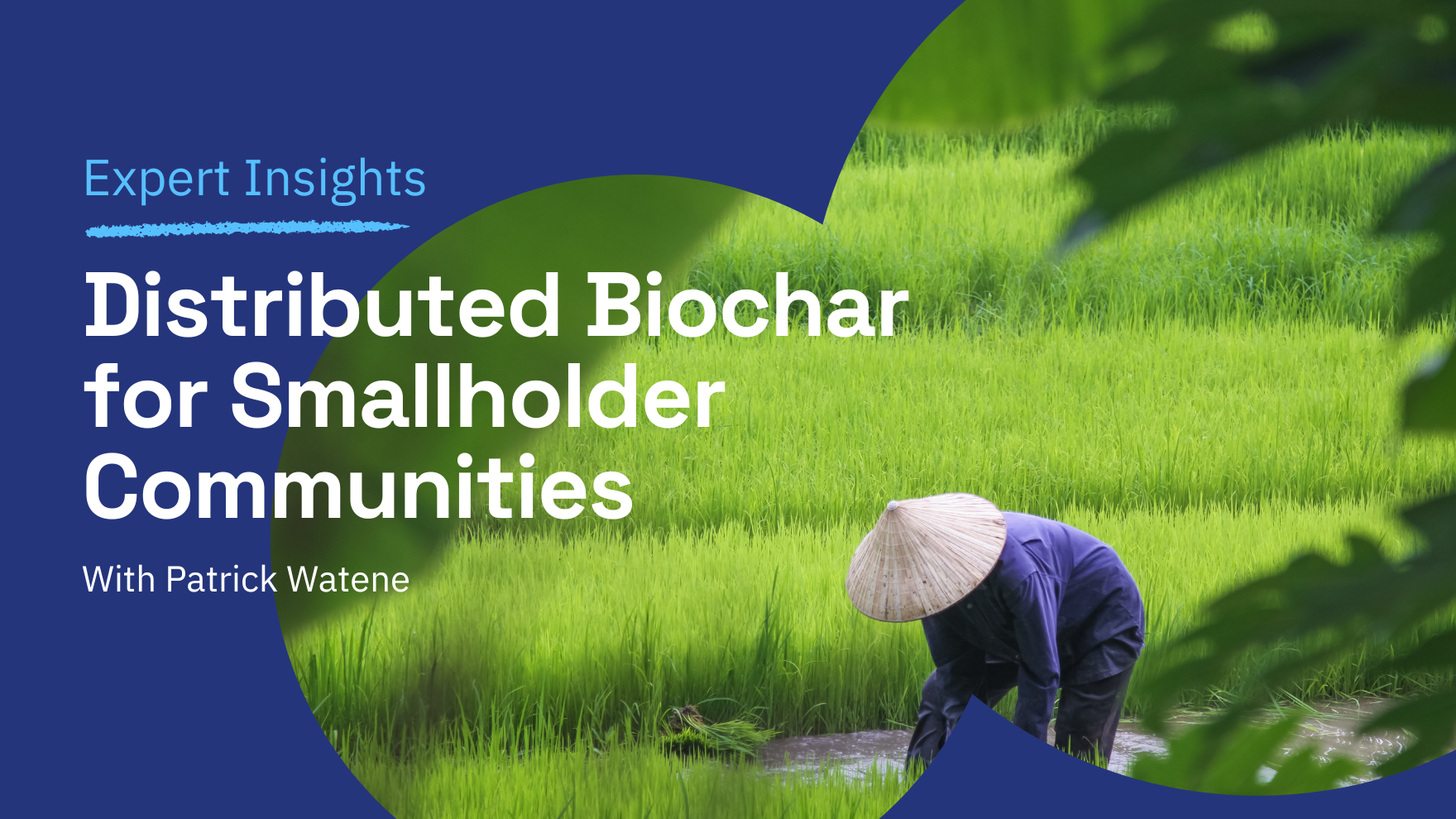
Intro
Distributed, community-scale biochar is often described as the “next frontier” for carbon removal in rural and smallholder farming regions. But turning that promise into real, durable carbon removal isn’t simple.
In this Expert Insight, Orejen Carbon Director Patrick Watene shares his perspective on what a high-integrity distributed biochar model should look like in practice – from technology choices and moisture constraints to ecosystem architecture and impact for smallholder communities.
Q1 – Why is distributed biochar for smallholder communities such an important topic right now?
Patrick:
Smallholder and rural communities are on the frontline of the climate crisis. They face crop loss, land degradation, and extreme weather – but they typically have the least access to climate finance and enabling infrastructure.
Distributed, community-scale biochar changes that equation. If we do it well, we can turn thousands of small farms into a network of high-integrity carbon removal nodes. Communities get better soils and new income streams, while buyers get verifiable, durable removals.
The catch is that good intentions and small kilns are not enough. Distributed projects have to meet the same integrity bar as industrial plants. That’s why the way we design these models – technologically, operationally, and institutionally – really matters.
Q2 – When you say “distributed biochar,” what kind of technology do you actually mean?
Patrick:
This is where a lot of confusion starts. Terms like “artisanal” or “low-tech” can cover everything from carefully engineered batch reactors to open flame-curtain kilns or even pits in the ground.
For high-integrity biochar carbon removal, that ambiguity is not okay.
When I talk about distributed projects, I mean:
Small-scale, community-operated, medium-tech enclosed pyrolysis systems – not open or flame-curtain kilns.
In practice, that looks like:
- Enclosed combustion and pyrolysis zones – no open burning.
- Controlled temperature ranges suitable for stable char formation.
- Emissions management, such as basic syngas handling, cracking zones, or flaring to minimise CH₄ and other by-products.
- Integrated digital MRV (dMMRV) – temperature traces, run logs, operator IDs, batch tracking, sampling data.
This is what I sometimes call the “enhanced artisan” category: systems simple enough for village-level use but engineered enough to produce repeatable outputs and trustworthy data.
Q3 – Moisture and methane: why do they matter so much in distributed models?
Patrick:
Feedstock moisture is one of those issues that seems “minor” until you’re actually in the field trying to run a reactor in the wet season.
Studies on open flame-curtain kilns show that wet biomass can depress combustion temperatures and drive smouldering, which significantly increases CH₄ emissions. That’s why methodologies are becoming stricter on moisture ranges – and that’s a good thing.
But it’s important to remember: those studies were mostly done on open systems – the very technologies that high-integrity frameworks are now excluding.
With enclosed, engineered batch reactors, especially those with syngas management and decent insulation, the moisture–emissions relationship can look different:
- Yes, if moisture is too high – say above 30–40% – you will destabilise temperatures in almost any system.
- But in an enclosed reactor with emissions controls, you may be able to operate within a slightly wider moisture band than open kilns, especially in tropical climates where perfect drying is unrealistic.
The right approach, in my view, is not to relax standards casually but to test moisture ranges empirically in pilot phases, under conservative safeguards, rather than hard-coding open-kiln numbers forever into enclosed-reactor rules.
Q4 – Sampling can be a huge burden for small projects. How do you think about sampling requirements?
Patrick:
On paper, strict rules like “1 sample per 15 kg, minimum 15 measurements per batch” look rigorous. In a lab or a single industrial plant, that’s achievable. In a rural setting where the operator is a farmer who has already worked all day, it can become completely unworkable.
For enclosed systems with stable thermal behaviour and timestamped temperature traces, we have other tools we can use to maintain integrity:
- Treat reactor-level process stability (temperature curves, run times) as the first line of defence.
- Use stratified sampling – heavier sampling early on to characterise the system, then reduced but still conservative sampling once stability is proven.
- Build sampling into digital workflows, so operators are guided on when and how to sample, and supervisors can audit both data and practices.
The key question isn’t “what sounds scientific?” but “what sampling regime gives us robust confidence in the data and is realistic for smallholder-operated systems over years?”
If the answer doesn’t work for farmers, then whatever we’ve designed will fail in the real world.
Q5 – You’ve talked about an “ecosystem-based” approach. What does that look like?
Patrick:
A lot of people still imagine distributed projects as a scatter of independent micro-units – each farmer with their own tiny kiln, acting alone.
That’s not how high-integrity distributed biochar works.
In practice, you need an ecosystem with a central project proponent or “hub” responsible for:
- Enrolment and onboarding of farmers, cooperatives, and local operators.
- Standardised dMMRV infrastructure – apps, devices, data schemas, storage.
- Training and certification of operators and supervisors.
- QA/QC, spot checks, and audits across units.
- Aggregated reporting so hundreds of small reactors operate as one coherent, accountable project.
The technology at the farm gate is only half the story. The architecture of the project – how people, hardware, data, and capital link up – is where integrity is either made or lost.
From our experience in Southeast Asia, this ecosystem orientation is absolutely fundamental. Without it, distributed models just don’t scale with integrity.
Q6 – Beyond carbon tonnes, what impact do you see for smallholder communities?
Patrick:
This is the part that excites me the most.
When done well, distributed biochar for smallholders can deliver co-benefits that big centralised facilities often struggle to reach:
- Circular nutrient flows and reduced dependence on synthetic fertilisers.
- Improved soil structure and water retention, helping crops withstand droughts and heavy rain.
- Less residue burning, which means less local air pollution and health risk.
- Stronger crop resilience and potentially better yields when biochar is matched to local soils.
- New income streams from durable carbon removal credits.
- Local jobs and skills development, often including youth and women who might otherwise have to leave for work.
The irony is that these projects frequently struggle to access funding, precisely because their value isn’t just a number on a carbon tonnage ledger. Their benefits are social, ecological, and circular-economy oriented, and our current market structures don’t always see or reward that properly.
Q7 – You’ve suggested an “IMPACT recognition pathway.” What would that mean in practice?
Patrick:
I think the market needs a clear way to recognise the broader impact profile of smallholder-centric projects – without weakening scientific standards on carbon.
One idea is an IMPACT recognition layer on top of existing durability and integrity criteria. It wouldn’t loosen core requirements. Instead, it would:
- Flag to buyers that a given removal delivers verified co-benefits – for soil health, livelihoods, circularity, climate justice, etc.
- Help channel capital from buyers who are explicitly looking for high-impact removals, not just the cheapest tonnes.
- Create space for Global South smallholder communities to participate meaningfully, rather than being outcompeted by large industrial facilities in already capital-rich regions.
- Complement industrial-scale biochar, which is also essential for gigaton-scale carbon removal.
In other words, we move from a one-dimensional “tonnes-only” view to a portfolio view of climate action, where different project types play different but equally valid roles.
Q8 – What do we still need to learn? Where do pilots come in?
Patrick:
No framework gets everything right on day one. That’s why structured pilots are so important.
There are a few key questions pilots should help answer:
- Moisture thresholds in enclosed reactors
- What moisture range is practically achievable in high-humidity environments, and how does it affect emissions in real-world use?
- Sampling protocols
- What is the minimum sampling intensity that still gives us robust confidence, and how do we bake it into daily operations?
- Operator and supervisor workflows
- What training, incentives, and digital tools make the system robust and repeatable, and where do things tend to break?
- Emissions performance and dMMRV
- How do these systems perform across feedstocks and climates, and are we capturing the right data at the right granularity?
- Guardrails vs flexibility
- Which standards must remain non-negotiable, and where can we safely allow context-specific flexibility?
If we can answer those questions transparently, distributed models can move from promising concepts to bankable, repeatable, scalable solutions.
Q9 – How is Orejen Carbon contributing to this space?
Patrick:
Orejen sits right in the middle of this “distributed ecosystem” problem.
We focus on:
- Building digital infrastructure and dMMRV systems that make sense for multi-unit, smallholder-oriented biochar projects.
- Working with partners on enclosed, community-scale pyrolysis technologies suitable for rural deployment.
- Helping design ecosystem architectures – connecting local operators, aggregators, verifiers, and buyers through coherent data and governance.
- Advocating for market designs that recognise the full impact profile of smallholder projects, while upholding strict scientific standards on durability and integrity.
We don’t see distributed biochar for smallholders as a niche or “nice-to-have.” It’s a core pillar of any serious climate strategy that cares about rural livelihoods, climate justice, and gigaton-scale removal.
Done right, it’s a way for communities who have contributed least to climate change to become key partners – and beneficiaries – in the solutions.
Other articles you may like:
Explore our cutting-edge technologies in carbon removal and sustainability.